




Pay-on-Success PR
A fee tied to an agreed result. No retainer to start.

Bond & Vale
Bond & Vale is a selective PR firm. Public relations here is pay-on-success: no retainer to start, and a fee when the coverage agreed in writing is delivered. The press program is the work. This page is how the fee is structured. Editors still decide what runs. The agreement says what counts.
- Written success criteria
- Markets that count
- Agreed time window
- Press program
- Interview preparation
- Fee on delivery
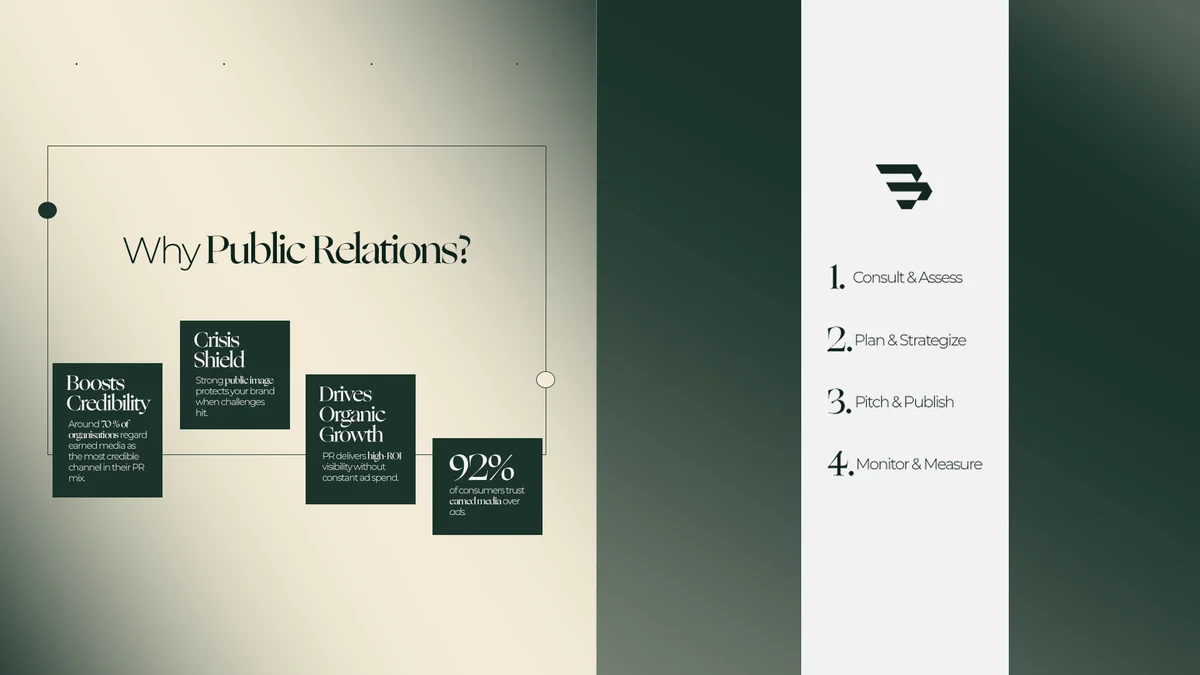
Agree what counts
Before outreach, both sides write down the result, the markets, and the window of time.
Check the facts
The story uses what the company can stand behind. If a fact is missing, the pitch waits.
Run the program
Outreach, briefing, and the plain assets a newsroom asks for, aimed at the agreed result.
Deliver, then invoice
The fee is due when that result is delivered. A result outside the written definition is not billed as success.
Companies that want the fee tied to a result
Pay-on-success PR is how Bond & Vale takes on public relations for companies in the United States and Canada. It is a performance-based arrangement: the firm is paid when the result written down at the start is delivered. People also look for this under names like a performance-based PR agency, pay per placement PR, or a results-based PR firm. The idea is the same. The wording of the agreement is what decides the engagement.
It suits a company that has done real work, can support a public story, and would rather pay for an agreed outcome than keep a monthly retainer running whether or not anything is published. It is a poor fit when the story is not ready, when nobody will be quoted, or when the only acceptable outcome is a guaranteed feature in one named outlet. We turn that work away. Bond & Vale is a Texas company. Clients are across the United States and Canada, and the people on an account work across North America.
What counts as a result
A result is defined before outreach starts, in writing, for that company. For public relations it is usually a kind of coverage: an article, an interview, or a segment, in the markets that matter to the business, inside an agreed window of time. The definition has to be specific enough to be met or missed. More awareness is not a result. A polite reply from a reporter is not a result. Coverage outside the markets you named is not the result you agreed, unless the written definition says it is.
Pay per placement, when that is the structure chosen, means the fee attaches to a placement that meets the written definition. It does not mean every mention on the internet is billable. A syndicated copy of the same article counts only if the agreement says it does. What counts is written down before anyone is pitched. If a piece runs and it matches that definition, it counts. If it does not match, it is not billed as success.
How and when the client pays
There is no retainer to begin. The terms of the site say the same thing as the practice: where the model applies, fees are based on agreed results rather than upfront retainers, and the criteria, the timeline, and the payment terms are defined in writing before the project starts. The fee is due when the agreed result is delivered.
We do not publish a rate card. The fee depends on the scope for that company: the kind of coverage, the markets, and the work required to put a true story in front of the right reporters. Those figures live in the agreement, not on this page. If a contract also names an expense or another item, that item is in the contract. We do not hide a monthly fee under another name. The terms are the general rule. The agreement for the company is the specific one.
What is promised and what is not
What you can count on is the commercial structure. You are not paying a retainer to keep a team on a clock. You pay when the written result is delivered. What is not promised is a yes from any particular editor, a feature in a publication named in a sales conversation, or a business outcome downstream of coverage, such as revenue, a hire, or a raise. Editors decide what they publish.
A results-based PR firm still cannot control a newsroom. The useful version of the promise is narrower. We agree what delivery means, we do the work, and the fee follows that delivery. If the agreed result is not delivered, the success fee for that result is not due. The written agreement is the document that says when an invoice is sent.
How this differs from a monthly retainer
A retainer buys time. A monthly fee keeps people available, and the work can continue whether or not a story runs. That can suit a company that wants an ongoing newsroom, a steady run of small announcements, or a team on call. It is a different product. Public relations at Bond & Vale is built the other way: a defined result, then a fee.
The tradeoff is scope. A pay-on-success engagement is not an open-ended department. It covers the result you wrote down. A second market, or a later campaign, is a new agreement. It is not an assumption that the first fee covers the year. Some companies keep a retainer with another firm for the always-on work and use a results-based engagement when a specific story needs to land. If the position itself is still unclear, start with brand consultancy. The press program that carries a ready story is public relations. When the public record is already the problem, start with reputation management.
Is this pay per placement?
It can be. If the written definition of delivery is a placement of a certain kind, the fee is tied to that placement. The agreement says what counts. A mention that falls outside it is not billed as success.
Do I pay a retainer if nothing runs?
There is no retainer to start. The success fee is due when the agreed result is delivered. If that result is not delivered, the success fee for it is not due. Anything else a contract covers is named in that contract.
Can you guarantee a story in a named outlet?
No. We agree the kind of coverage that counts as delivery. The newsroom decides whether to run the story. You pay when that agreed result is delivered.
Who is this a good fit for?
A company in the United States or Canada with a true story, a person who will be quoted, and a preference for paying on an agreed result. It is a poor fit if the only acceptable outcome is a guaranteed feature in one named title.
How is this different from the public relations page?
The public relations page describes the press program: the narrative, the outreach, and what a useful placement changes. This page describes the commercial model that program uses. The work itself is public relations.